Healthcare Communication
That Reduces
Psychological Friction.
My approach to healthcare communication is informed by the Health Belief Model (HBM), a behavioral healthcare framework developed by social psychologists Godfrey Hochbaum, Irwin Rosenstock, and Stephen Kegels in the 1950s to better understand why people engage, or hesitate to engage, in healthcare decisions.
The framework remains highly relevant today because healthcare decisions are rarely driven by information alone. Patients often navigate uncertainty, hesitation, trust, reassurance-seeking, perceived seriousness, and psychological resistance before deciding whether professional care feels necessary.
This framework shapes how I approach healthcare communication, patient interpretation, emotional readiness, and psychological barriers to care.


My Healthcare Communication Framework
Healthcare Communication
That Reduces
Psychological Friction.
My approach to healthcare communication is informed by the Health Belief Model (HBM), a behavioral healthcare framework developed by social psychologists Godfrey Hochbaum, Irwin Rosenstock, and Stephen Kegels in the 1950s to better understand why people engage, or hesitate to engage, in healthcare decisions.
The framework remains highly relevant today because healthcare decisions are rarely driven by information alone. Patients often navigate uncertainty, hesitation, trust, reassurance-seeking, perceived seriousness, and psychological resistance before deciding whether professional care feels necessary.
This framework shapes how I approach healthcare communication, patient interpretation, emotional readiness, and psychological barriers to care.

Healthcare communication often works differently from ordinary social media content.
Rather than functioning purely as direct-response marketing, healthcare content often works as psychological infrastructure and gradually reducing uncertainty, hesitation, emotional resistance, and barriers to seeking care over time.
Patients rarely make healthcare decisions instantly. In reality, many people:
revisit clinic websites multiple times
compare different sources of information
seek reassurance from family or online communities
emotionally process uncertainty over time
delay action before finally seeking care
This means healthcare communication often works cumulatively rather than immediately.
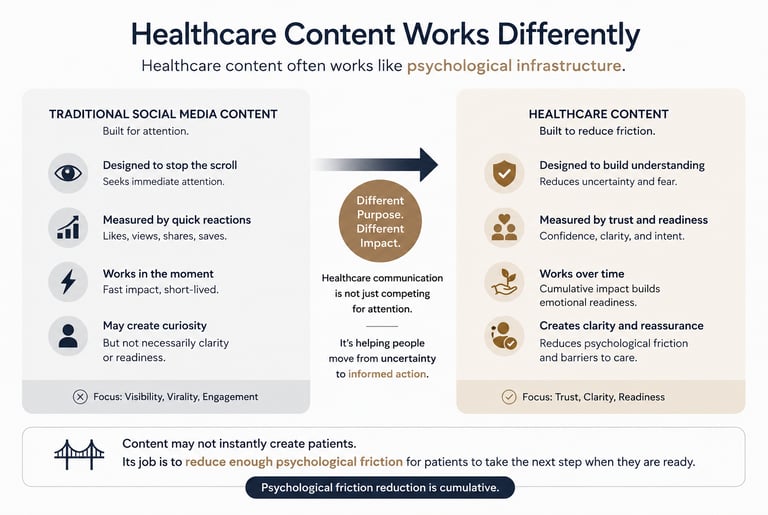
Healthcare Content Works Differently
Its role is not only immediate visibility or engagement. Good healthcare communication gradually reduces uncertainty, hesitation, emotional resistance, and barriers to care over time.
Content may not instantly create patients. Often, its role is to reduce enough psychological friction for patients to feel more reassured, informed, and emotionally prepared to take the next step when needed.
Psychological friction reduction is cumulative.
Healthcare content often works like psychological infrastructure.
Its role is not only immediate visibility or engagement. Good healthcare communication gradually reduces uncertainty, hesitation, emotional resistance, and barriers to care over time.
Content may not instantly create patients. Often, its role is to reduce enough psychological friction for patients to feel more reassured, informed, and emotionally prepared to take the next step when needed.
Psychological friction reduction is cumulative.
Healthcare content often works like
psychological infrastructure.
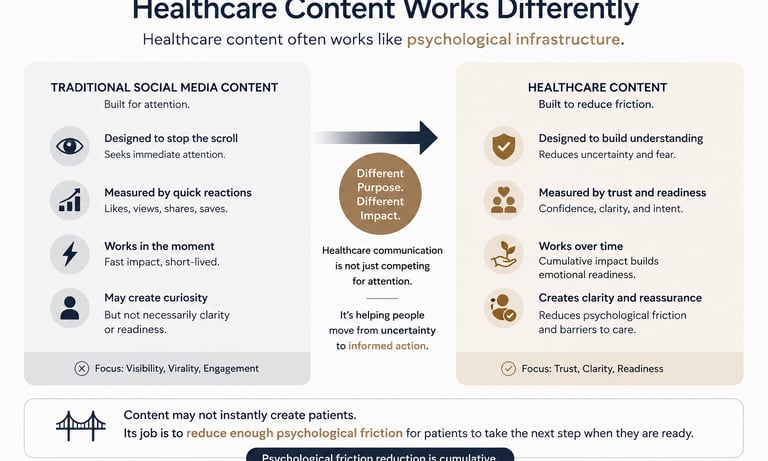
Metrics still matter. Clinics still need visibility, discoverability, patient inquiries, and growth.
However, healthcare communication also shapes patient interpretation, trust, reassurance, expectation-setting, and emotional readiness — factors that are not always immediately visible through engagement numbers alone.
A healthcare post may go viral while:
exaggerating seriousness
creating unnecessary panic
attracting low-quality leads
encouraging unrealistic expectations
Examples include:
fear-based symptom hooks such as “Never ignore this sign”
heavily exaggerated aesthetic transformation content
At the same time, calmer educational communication may spread more slowly while quietly building trust, reducing hesitation, improving patient understanding, and attracting more intentional patients over time.
The goal is not to ignore metrics but to balance visibility with psychologically responsible healthcare communication.
Beyond Virality and Engagement
How Referral and Content Work Together
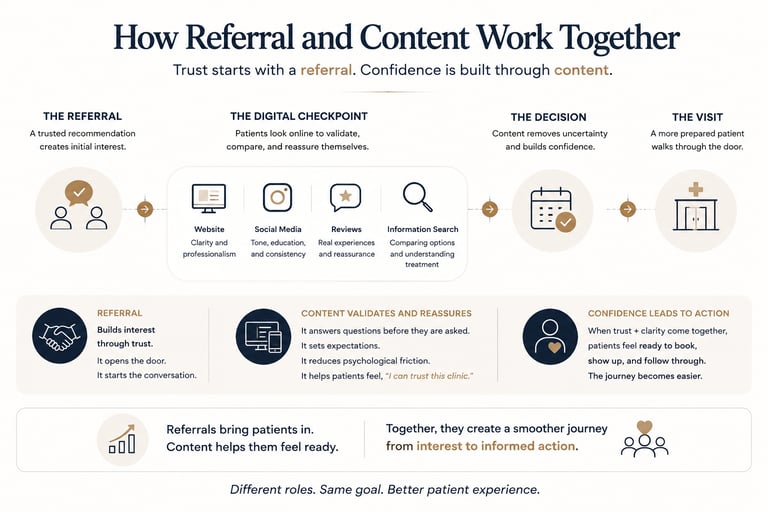
Referrals remain one of the strongest forms of healthcare trust. However, modern patient behavior is increasingly digital.
Even when patients are referred by friends, family, or other healthcare professionals, many still look online before deciding whether they feel confident moving forward.
Before booking a consultation, patients often:
visit clinic websites
browse Instagram pages
read reviews
observe communication tone
compare online presence
look for reassurance and clarity
This means healthcare content often reinforces and validates referral confidence before patients ever step into the clinic.
Strong healthcare communication helps referred patients feel:
more reassured
more informed
more emotionally prepared
more confident seeking care
Content and referrals are not separate systems.
In many cases, they work together to reduce uncertainty and help patients feel more ready to take the next step.
Referrals remain one of the strongest forms of healthcare trust. However, modern patient behavior is increasingly digital.
Even when patients are referred by friends, family, or other healthcare professionals, many still look online before deciding whether they feel confident moving forward.
Before booking a consultation, patients often:
visit clinic websites
browse Instagram pages
read reviews
observe communication tone
compare online presence
look for reassurance and clarity
This means healthcare content often reinforces and validates referral confidence before patients ever step into the clinic.
Strong healthcare communication helps referred patients feel:
more reassured
more informed
more emotionally prepared
more confident seeking care
Content and referrals are not separate systems.
In many cases, they work together to reduce uncertainty and help patients feel more ready to take the next step.
How Referral and Content Work Together
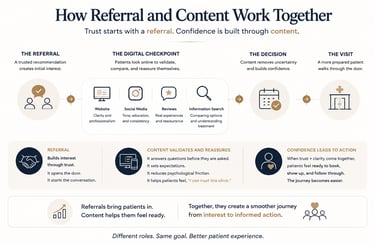
Beyond Visibility
Healthcare communication is not only about attention.
It is also about helping patients navigate uncertainty more responsibly, confidently, and with less psychological friction over time.
Good communication does more than attract views.
It helps patients feel:
more reassured
more informed
more emotionally prepared
more confident taking the next step when needed
Because healthcare decisions are rarely instant.
Trust, readiness, and reassurance are often built gradually, through consistent communication that helps people feel understood rather than pressured.