High Ranking. Low Conversion. Why Healthcare Articles Don’t Lead to Patient Visits
Most healthcare articles rank well and clearly explain medical conditions but still fail to bring patients into the clinic. Here’s why healthcare articles perform in search but struggle to translate into real patient visits.
Wulan
5/4/20267 min read


Many healthcare articles are well-written, accurate, and aligned with search intent. They answer questions effectively and perform as expected from an SEO standpoint.
Yet despite this, they often do not translate into patient visits.
Patients can read, understand, and even agree with the information presented, but still remain uncertain about how it applies to their own situation.
This gap points to a deeper issue. Not in the quality of information, but in how healthcare articles are structured in relation to patient behaviour.
Rank on Google, Failed on Conversion. Sadly, this is the truth with most healthcare articles.
A healthcare article can rank on the first page of Google, attract consistent traffic, and clearly explain a condition, yet still fail to bring patients into the clinic.
Many healthcare articles are well-written, accurate, and aligned with search intent. They answer questions effectively and perform as expected from an SEO standpoint.
Yet despite this, they often do not translate into patient visits.
Patients can read, understand, and even agree with the information presented, but still remain uncertain about how it applies to their own situation.
This gap points to a deeper issue. Not in the quality of information, but in how healthcare articles are structured in relation to patient behaviour.
Rank on Google,
Failed on Conversion.
Sadly, this is the truth with most
healthcare articles.
A healthcare article can rank on the first page of Google, attract consistent traffic, and clearly explain a condition, yet still fail to bring patients into the clinic.
Healthcare Articles Are Built for Search, Not for Patient Reality
Most healthcare articles are structured around how people search.
They are designed to:
match keywords
define conditions clearly
list symptoms
provide explanations
This structure aligns well with search engines and ensures visibility.
However, it does not fully reflect how patients experience symptoms or process health information.
Patients are not engaging with healthcare articles simply to learn. They are trying to understand what their symptoms mean in the context of their own situation, often while dealing with uncertainty or concern.
This creates a mismatch between:
how healthcare articles are written
and how patients actually use them
Information Increases Awareness, But Not Application
From a behavioural perspective, this limitation aligns with the Health Belief Model (HBM).
The model suggests that individuals are more likely to act when they:
perceive a condition as personally relevant
understand its seriousness
and believe that action is necessary at that point in time
Healthcare articles are generally effective at increasing awareness.
They explain symptoms and provide clear medical information.
However, awareness alone does not establish:
whether the condition applies to the patient
how serious it is in their specific case
or whether immediate action is required
These require contextual interpretation.
As a result, patients may understand what they read, but still hesitate to take the next step.
The Cognitive Load Problem in Healthcare Articles
Healthcare articles often present:
multiple symptoms
detailed explanations
different possible causes
several recommended actions
While each element may be clear individually, the overall experience becomes cognitively demanding.
According to Cognitive Load Theory, individuals have limited capacity to process and organise complex information.
When too many elements are presented without clear structure or prioritisation, patients are required to:
connect information themselves
determine relevance
decide what matters
In healthcare contexts, where uncertainty and perceived risk are already present, this often results in hesitation rather than clarity.


The Cognitive Load Problem in Healthcare Articles
Healthcare articles often present:
multiple symptoms
detailed explanations
different possible causes
several recommended actions
While each element may be clear individually, the overall experience becomes cognitively demanding.
According to Cognitive Load Theory, individuals have limited capacity to process and organise complex information.
When too many elements are presented without clear structure or prioritisation, patients are required to:
connect information themselves
determine relevance
decide what matters
In healthcare contexts, where uncertainty and perceived risk are already present, this often results in hesitation rather than clarity.
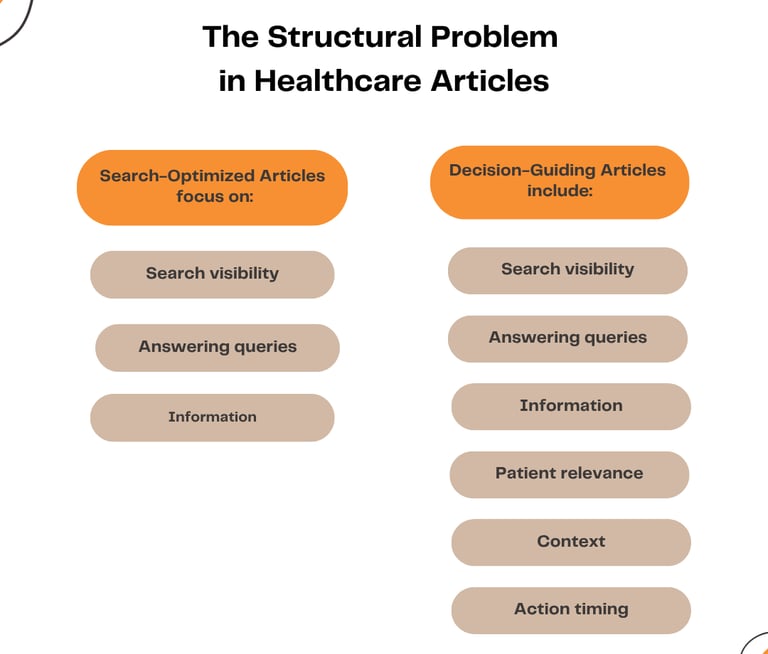
The Structural Problem in Healthcare Articles
Most healthcare articles follow a familiar format:
Definition → Symptoms → Explanation → Advice
This format is effective for delivering information.
But it assumes that once information is understood, it can be easily applied.
In reality, patients do not experience symptoms as isolated data points. They experience them as patterns, influenced by context, timing, and severity.
When symptoms are presented as lists, and advice is presented without prioritisation, patients are left to interpret everything on their own.
The article informs but does not translate into real-world relevance.
The Structural Problem in Healthcare Articles
Most healthcare articles follow a familiar format:
Definition → Symptoms → Explanation → Advice
This format is effective for delivering information.
But it assumes that once information is understood, it can be easily applied.
In reality, patients do not experience symptoms as isolated data points. They experience them as patterns, influenced by context, timing, and severity.
When symptoms are presented as lists, and advice is presented without prioritisation, patients are left to interpret everything on their own.
The article informs but does not translate into real-world relevance.
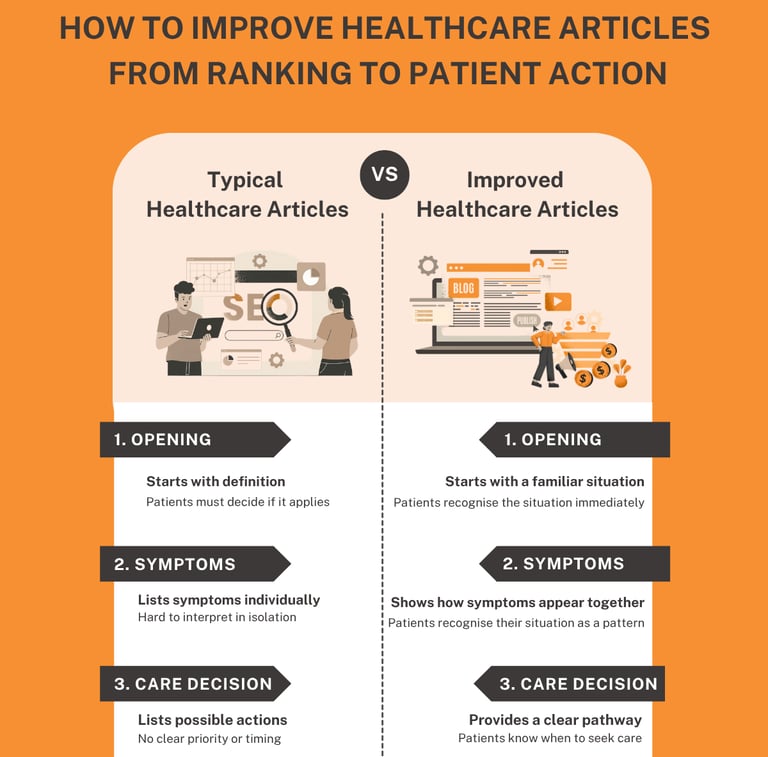
How Most Healthcare Articles Create Friction
Most healthcare articles are designed to maximise clarity and completeness. However, in practice, the structure often increases the amount of interpretation patients must do on their own.
From an informational perspective, these approaches are logical and medically thorough.
From a behavioural perspective, they create friction.
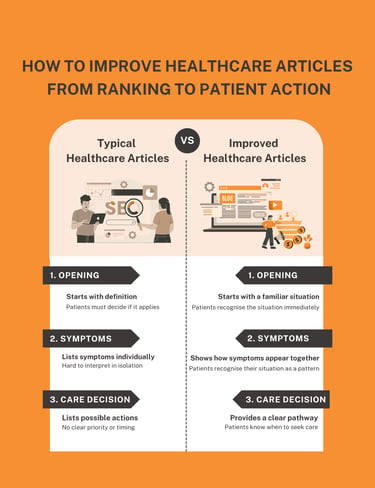
1. Opening: relevance is established too late
Many healthcare articles begin with medical definitions before establishing personal relevance.
Patients are immediately placed in a position where they must decide whether the condition being described actually relates to their own experience.
While medically accurate, the structure creates distance between the information and the patient’s situation.
2. Symptoms: information is presented in isolation
Symptoms are often presented as isolated lists rather than connected experiences.
Patients are then required to determine whether separate pieces of information collectively reflect what they are experiencing in real life.
This increases interpretation burden, especially when symptoms vary in intensity, timing, or combination.
3. Advice: information lacks prioritisation
Healthcare articles frequently include large amounts of information without clearly distinguishing what is most relevant or urgent.
Patients are expected to decide:
what matters most
what can be monitored
what requires medical attention
and when action becomes necessary
As the amount of interpretation increases, uncertainty increases with it.
Patients are not processing healthcare information in neutral conditions. They are often reading while uncertain, anxious, uncomfortable, or attempting to evaluate potential risk.
When relevance, context, and urgency are not immediately clear, interpretation burden increases. Patients may understand the information itself while still remaining uncertain about how it applies to them personally.
This is where many healthcare articles lose effectiveness.
The issue is often not the quality of the information provided, but the amount of interpretation required after the reading process.
How Most Healthcare Articles Create Friction
Most healthcare articles are designed to maximise clarity and completeness. However, in practice, the structure often increases the amount of interpretation patients must do on their own.
From an informational perspective, these approaches are logical and medically thorough.
From a behavioural perspective, they create friction.
1. Opening: relevance is established too late
Many healthcare articles begin with medical definitions before establishing personal relevance.
Patients are immediately placed in a position where they must decide whether the condition being described actually relates to their own experience.
While medically accurate, the structure creates distance between the information and the patient’s situation.
2. Symptoms: information is presented in isolation
Symptoms are often presented as isolated lists rather than connected experiences.
Patients are then required to determine whether separate pieces of information collectively reflect what they are experiencing in real life.
This increases interpretation burden, especially when symptoms vary in intensity, timing, or combination.
3. Advice: information lacks prioritisation
Healthcare articles frequently include large amounts of information without clearly distinguishing what is most relevant or urgent.
Patients are expected to decide:
what matters most
what can be monitored
what requires medical attention
and when action becomes necessary
As the amount of interpretation increases, uncertainty increases with it.
Patients are not processing healthcare information in neutral conditions. They are often reading while uncertain, anxious, uncomfortable, or attempting to evaluate potential risk.
When relevance, context, and urgency are not immediately clear, interpretation burden increases. Patients may understand the information itself while still remaining uncertain about how it applies to them personally.
This is where many healthcare articles lose effectiveness.
The issue is often not the quality of the information provided, but the amount of interpretation required after the reading process.
What Effective Healthcare Articles Do Differently
Effective healthcare articles are not necessarily more detailed.
The difference often lies in how information is structured around patient experience, recognition, and action.
High-performing healthcare articles reduce interpretation burden by helping patients recognise relevance earlier, understand symptom patterns more clearly, and navigate care decisions with less uncertainty.
The future of healthcare content is no longer defined by how well information is delivered. It is defined by how effectively information reduces uncertainty, establishes relevance, and supports real patient action.
Patients do not delay because information is unavailable. They delay when relevance feels uncertain, symptoms feel difficult to interpret, and the next step remains unclear.
Ranking on Google is only the beginning of the patient journey.
What brings patients into the clinic is when information feels personally relevant, understandable, and connected to their real situation.
About the Author
Wulan writes about healthcare communication, emotional behavior, and how digital interaction is reshaping patient trust and engagement.
What Effective Healthcare Articles Do Differently
Effective healthcare articles are not necessarily more detailed.
The difference often lies in how information is structured around patient experience, recognition, and action.
High-performing healthcare articles reduce interpretation burden by helping patients recognise relevance earlier, understand symptom patterns more clearly, and navigate care decisions with less uncertainty.
The future of healthcare content is no longer defined by how well information is delivered. It is defined by how effectively information reduces uncertainty, establishes relevance, and supports real patient action.
Patients do not delay because information is unavailable. They delay when relevance feels uncertain, symptoms feel difficult to interpret, and the next step remains unclear.
Ranking on Google is only the beginning of the patient journey.
What brings patients into the clinic is when information feels personally relevant, understandable, and connected to their real situation.
About the Author
Wulan writes about healthcare communication, emotional behavior, and how digital interaction is reshaping patient trust and engagement.
Explore how strategic communication can support patient trust, engagement, and digital positioning in modern healthcare.
Interested in healthcare communication strategy?